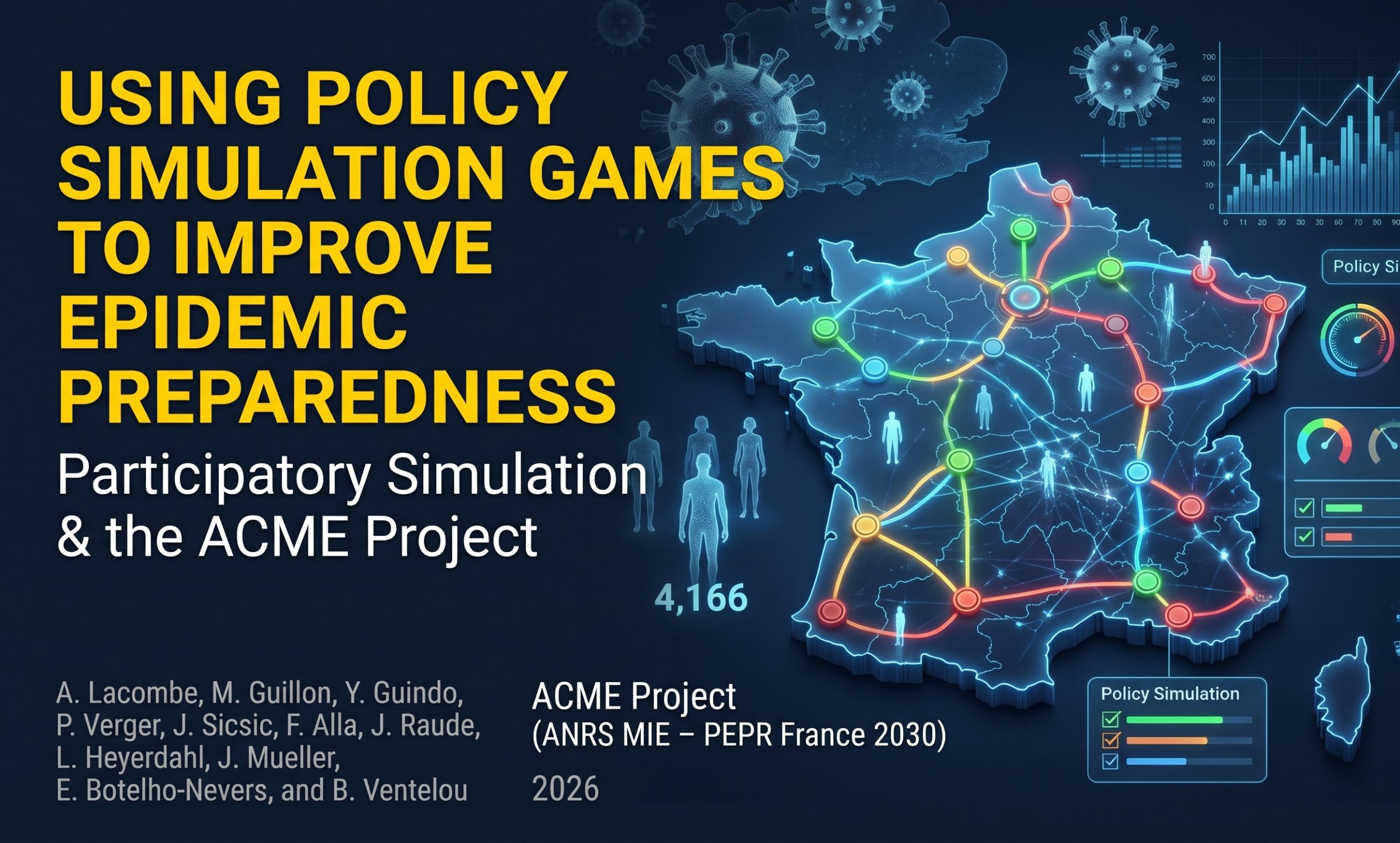
Using Policy Simulation Games to Improve Epidemic Preparedness
Using Policy Simulation Games to Improve Epidemic Preparedness
New research explores how public preferences can inform the design of effective and socially acceptable epidemic-response strategies.
How can policymakers design epidemic-response strategies that are both effective and acceptable to the public?
A research team involving Antoine Lacombe and colleagues from Aix-Marseille University and partner institutions addresses this question through an innovative approach based on Participatory Value Evaluation (PVE), which allows individuals to simulate policy decisions by selecting combinations of public health measures under different epidemic scenarios.
Conducted as part of the ACME Project (ANRS MIE – PEPR France 2030), the study examines how individuals choose portfolios of preventive measures while accounting for their expected effects on hospital occupancy.
The researchers first identified relevant epidemic scenarios and public-health interventions through an expert-based assessment. They then conducted a policy simulation experiment involving **4,166 respondents representative of the French population**, asking participants to select combinations of measures aimed at reducing projected hospital occupancy below a specified threshold.
Using multinomial logit models, the study estimates preferences for different countermeasures across three epidemic scenarios: respiratory, vector-borne, and food- and water-borne disease outbreaks.
The findings highlight an important consideration for public-health preparedness: **the acceptability of epidemic-response strategies depends not only on their expected epidemiological effectiveness but also on the specific combination of measures implemented.
These results underscore the importance of integrating public preferences alongside epidemiological expertise when designing epidemic-response policies. Participatory simulation tools offer a promising approach to developing strategies that are both effective and socially acceptable.
Research team: A. Lacombe, M. Guillon, Y. Guindo, P. Verger, J. Sicsic, F. Alla, J. Raude, L. Heyerdahl, J. Mueller, E. Botelho-Nevers, and B. Ventelou.
Project: ACME – ANRS MIE – PEPR France 2030
Contact: Antoine Lacombe, Postdoctoral Researcher, Aix-Marseille School of Economics (AMU)
antoine.lacombe@univ-amu.fr
Read the research poster for further information on the methodology, simulation experiment, and findings.